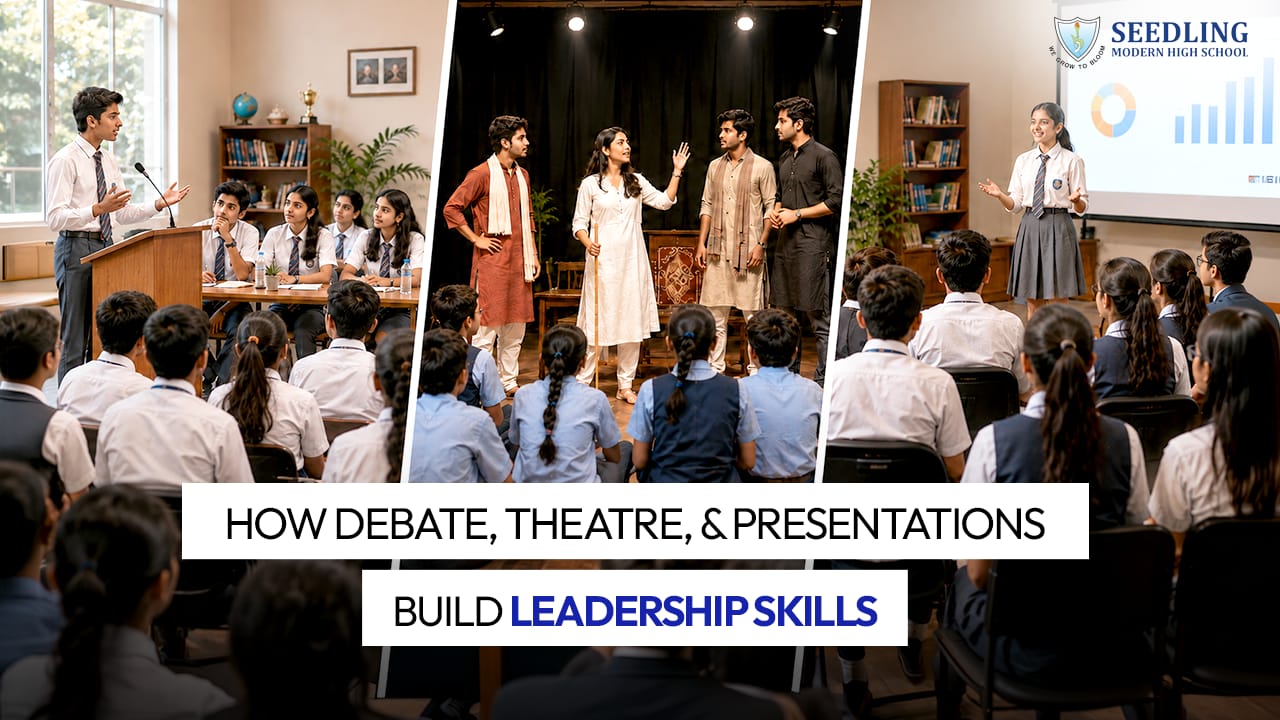
How Debate, Theatre, and Presentations Build Leadership Skills
Leadership isn’t something children suddenly develop when they become adults. It grows through everyday experiences that encourage them to communicate confidently, think independently, collaborate with others, and take responsibility.
Activities such as debates, theatre, and classroom presentations do far more than improve public speaking. They help students develop confidence, empathy, critical thinking, teamwork, and decision-making skills that are valuable both inside and outside the classroom. This is one of the reasons many parents looking for the best CBSE school in Jaipur or an English medium school in Jaipur also consider the opportunities a school provides beyond academics.
According to the National Education Policy (NEP) 2020, school education should focus on holistic development by nurturing key 21st-century skills such as communication, collaboration, creativity, and critical thinking alongside academic learning.
Let’s explore how these activities contribute to leadership development from an early age.
Admissions Open
Give Your Child the Best Start
Join Seedling Modern High School and unlock a world-class learning environment built for tomorrow's leaders.
Apply for Admission →In This Article
Leadership Begins with Confident Communication
Children who regularly participate in debates, presentations, or stage performances gradually become more comfortable expressing their thoughts. They learn to organise ideas, communicate clearly, and respond confidently to different audiences.
Rather than simply speaking well, they also learn to listen actively, respect diverse viewpoints, and express their opinions with clarity and confidence.
This approach aligns with the National Curriculum Framework for School Education (NCF-SE) 2023, which encourages discussion-based learning, classroom interaction, collaborative activities, and active student participation to develop communication, critical thinking, and social competencies.
Communication is only one part of leadership; collaboration is equally important.
Learning to Work as a Team
Theatre productions, group presentations, and debate competitions help students develop collaboration, communication, and shared responsibility as they work towards a common goal. Through these experiences, they learn to:
- Share responsibilities
- Respect different perspectives
- Solve problems collaboratively
- Support one another under deadlines
- Develop accountability
These experiences reflect real-world situations where effective leaders work with others to achieve shared goals. The National Education Policy (NEP) 2020 and the National Curriculum Framework for School Education (NCF-SE) 2023 encourage collaborative, discussion-based, and experiential learning that helps students build communication, cooperation, and social skills alongside academic learning.
Along with collaboration, effective leadership also requires students to think independently and make informed decisions.
Developing Critical Thinking and Decision-Making
Debates encourage students to research topics, analyse evidence, and evaluate different viewpoints before presenting an argument. Similarly, presentations require students to organise information logically, while theatre encourages them to understand emotions, perspectives, and real-life situations through storytelling.
This approach aligns with UNESCO’s vision for education, which emphasises developing critical thinking, communication, collaboration, and responsible citizenship competencies that prepare learners for lifelong learning and active participation in society.
Beyond academic growth, these experiences also strengthen students’ social and emotional skills.
Building Empathy, Confidence, and Resilience
Standing before an audience can feel challenging at first. Over time, repeated participation helps students become more confident and resilient.
Theatre, in particular, encourages children to step into different roles and perspectives, helping them understand emotions, build empathy, and develop stronger interpersonal skills.
Research by CASEL (Collaborative for Academic, Social, and Emotional Learning) highlights that activities promoting self-awareness, relationship skills, responsible decision-making, and communication contribute significantly to students’ overall development.
Schools can nurture these qualities by creating regular opportunities for participation.
Creating Everyday Leadership Opportunities at School
Leadership isn’t limited to student council positions or competitions. It develops whenever students are encouraged to participate, collaborate, and communicate.
At Seedling Modern High School (SMHS), activities such as debates, theatre performances, presentations, classroom discussions, and collaborative projects provide students with opportunities to strengthen communication, teamwork, creativity, and confidence while complementing their academic learning.
Conclusion
Leadership grows through consistent practice rather than a single achievement. Activities like debate, theatre, and presentations help students become confident communicators, thoughtful decision-makers, empathetic teammates, and responsible individuals.
For parents searching for a CBSE school in Jaipur, it is worth looking beyond academic results to see how a school encourages communication, collaboration, creativity, and leadership through everyday learning experiences. These opportunities help prepare students not only for examinations but also for higher education, future careers, and everyday life.
Frequently Asked Questions
1. How do debates improve leadership skills?
They build confidence, critical thinking, communication, and decision-making.
2. Why is theatre important for students?
It develops confidence, creativity, teamwork, and empathy.
3. Do presentations help children become better communicators?
Yes. They improve public speaking, organisation, and self-confidence.
4. Can shy students benefit from these activities?
Yes. Regular participation gradually builds confidence and communication skills.
5. Why are leadership skills important in school?
They prepare students to collaborate, solve problems, and communicate effectively in future academic and professional settings.
Ready to Enrol?
Begin Your Admission Journey
Seats are limited. Secure your child's place at Seedling Modern High School today.
Enquire Now →Written by
SPS Editorial Team
SPS Editorial Team creates trusted educational content for Seedling Public School (SPS). Our articles are developed with insights from experienced educators and academic professionals, ensuring every piece is accurate, practical, and relevant. We are committed to providing reliable resources that support students, parents, and lifelong learning.