How Play-Based Learning Shapes the Early Years at Seedling Wonderland Kids League
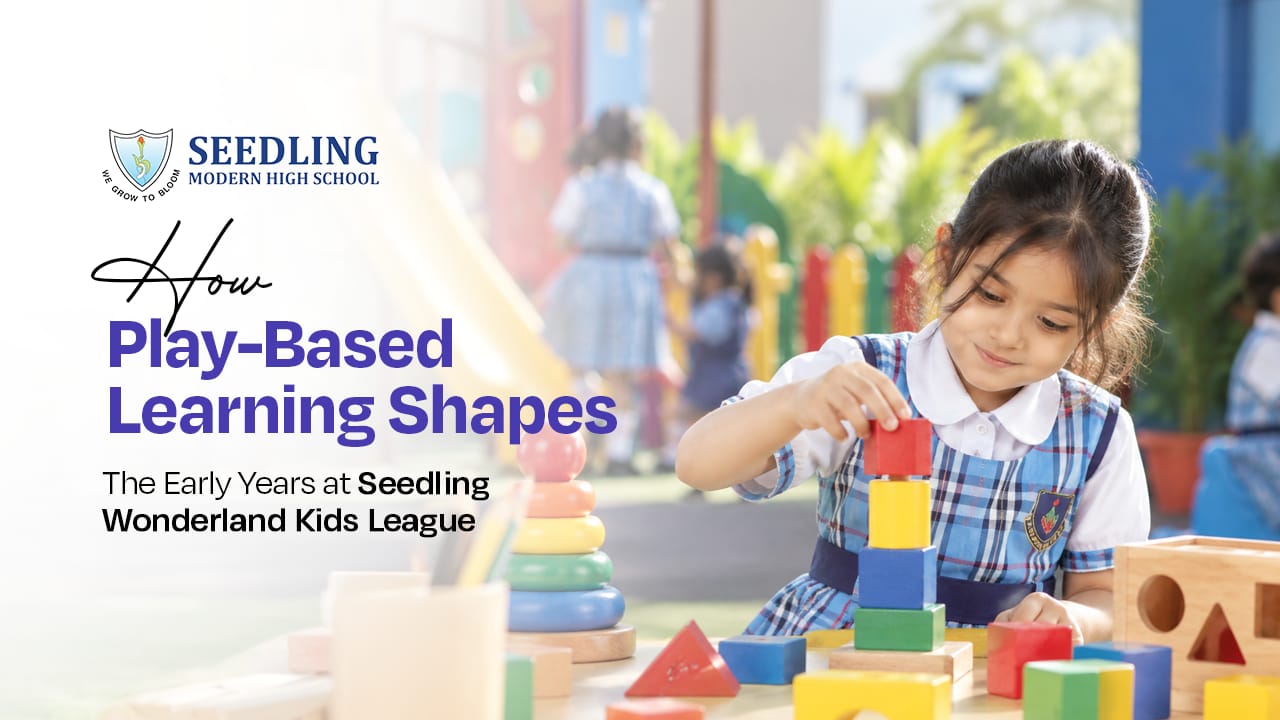
For a young child, learning may begin with building a tower, pretending to run a shop, sorting objects by colour, listening to a story, or trying to make a paper structure stand. It may not look like a traditional lesson, but the child could be observing, communicating, comparing, remembering, making decisions, and trying again.
That is the value of play-based learning in early childhood education. Play gives young children opportunities to explore ideas through experiences that are active, meaningful, and appropriate to their stage of development. UNICEF highlights play, exploration, and hands-on experiences as important elements of effective early childhood learning.
The important question, therefore, is not simply whether a child is playing. It is what the child is learning while playing.
In This Article
Why Play Matters in the Early Years
The early years are a period of rapid development. Children are building foundations for language, thinking, movement, relationships, and self-regulation through their everyday interactions with people and their surroundings.
Admissions Open
Give Your Child the Best Start
Join Seedling Modern High School and unlock a world-class learning environment built for tomorrow's leaders.
Apply for Admission →Play creates opportunities to practise these skills repeatedly. Consider a child building a tower with blocks. They may compare sizes, decide which piece should go next, test whether the structure will balance, and change their approach when it falls. A seemingly simple activity can involve observation, planning, problem-solving, and persistence.
Play can also provide practice for emerging executive-function skills. Harvard’s Center on the Developing Child identifies playful activities as opportunities for children to practise skills related to attention, working memory, and self-control.
This is why play has an important place in early childhood education. Children are not merely passing time. They are using their developing abilities in situations they can understand and actively participate in.
What Children Are Really Learning Through Play
One activity can involve several kinds of learning at once. What looks like a simple game or classroom activity can give children opportunities to observe, communicate, make decisions, solve problems, and try different approaches.
| What the child does | What the child may be learning |
| Sorts buttons, blocks, or objects by colour or size | Notices similarities and differences, compares objects, and begins to recognise patterns and categories |
| Listens to a story and recreates it with puppets | Builds vocabulary, remembers events, follows sequences, and expresses ideas |
| Builds a tower or structure | Explores size, shape, balance and space while planning and adjusting an approach |
| Sings a song or joins an action rhyme | Practises listening, memory, language, rhythm, and coordinated movement |
| Creates something with craft materials | Makes choices, handles materials, experiments with possibilities, and expresses ideas |
| Takes part in role-play | Practises conversations, explores familiar situations, and responds to other people’s ideas |
The same activity can therefore support more than one area of development. A child building with blocks, for example, may be developing early mathematical thinking while also practising persistence and communication with another child.
This is one of the strengths of play-based learning in preschool. Learning does not have to be divided into separate boxes labelled language, mathematics, creativity, or social development. A meaningful experience can bring several areas together while allowing children to remain active participants in what they are doing.
Guided Play Turns Everyday Activities Into Learning Opportunities
Play-based learning does not mean that children are simply left to do whatever they want.
There is an important difference between unstructured free time and purposeful or guided play. NAEYC’s guidance on developmentally appropriate practice recognizes play as part of intentional early learning and describes a continuum that includes child-directed play, guided play, and more direct forms of teaching.
In guided play, children can remain active participants while an adult creates an environment, introduces suitable materials, or asks questions that extend their thinking.
For example, instead of telling a child exactly how to build a bridge with blocks, a teacher might ask:
“What could you change to make it stronger?”
The child then has an opportunity to test an idea rather than simply follow an instruction.
Similarly, a teacher might use a story to encourage children to predict what happens next, introduce sorting materials to explore categories, or ask children to describe the shape, texture, or colour of an object.
The learning objective is present, but the child is still doing the exploring.
What Play-Based Learning Looks Like at Seedling Wonderland Kids League
At Seedling Wonderland Kids League, the published early-years programme includes educational songs, action-based nursery rhymes, storytelling, puppets, educational toys, craft activities, audio-visual aids, and practical demonstrations involving objects, shapes, colours and sizes.
These activities provide different ways for children to encounter and explore concepts. A child may hear an idea through a song, see it demonstrated with an object, discuss it through a story, or explore it through a practical activity.
Seedling’s published prospectus also describes open-ended activities in which children can begin from their own level and work at their own pace.
That is particularly relevant in the early years because children do not necessarily develop every ability at exactly the same pace. Providing opportunities to explore, practise and respond at an individual level can make classroom experiences more meaningful.
For families looking at the Durgapura location, Seedling’s published school information lists Seedling Wonderland Kids League at Ashok Marg, Mahaveer Nagar-II, the same campus location associated with the Seedling Modern High School campus.
The Teacher’s Role Is More Than Giving Instructions
A teacher plays an important role in turning play into a meaningful learning experience.
Sometimes that means introducing an activity. At other times, it means observing without immediately intervening. A teacher may notice that a child is struggling to balance blocks, for example, and respond with a question rather than a solution.
“What happens if you put the larger block underneath?”
That small prompt can encourage the child to observe, predict, and test an idea independently.
Teachers can also extend children’s language by asking them to describe what they are doing, encourage children to explain their choices, or help them consider another way of approaching a problem.
This is why play-based learning should not be confused with unstructured free time. It can involve thoughtful planning, suitable materials, observation, and responsive interaction. NAEYC’s developmentally appropriate practice guidance places play within an intentional approach to children’s learning and development.
What Parents Can Look For Beyond Worksheets
For parents, a useful measure of early learning is not only how many worksheets a child has completed.
Try asking:
- What did my child try today?
- Did they ask a question?
- Did they find another way when something did not work?
- Did they explain what they made or discovered?
- Did they listen or respond to another child?
- Did they stay engaged with an activity?
- Did they make a choice independently?
These observations can reveal aspects of learning that a worksheet may not capture.
Parents can encourage similar experiences at home through everyday activities. Sorting laundry by colour, counting household objects, making up stories, building with blocks, drawing, singing together, or pretending to run a shop can all create opportunities for children to talk, think, experiment, and make decisions.
UNICEF also highlights everyday interactions such as talking, listening, storytelling, singing, and play as valuable experiences for children’s early development.
The goal is not to turn every game into a lesson. It is to recognise that children can learn through ordinary experiences when they have opportunities to explore, communicate, make choices, and try things for themselves.
FAQs
1. Is play-based learning the same as free play?
No. Free play can be child-directed, while guided play combines children’s active exploration with intentional learning goals and teacher support. Both can have a place in early childhood education.
2. How long should a play-based activity last?
There is no fixed duration. Activities can vary according to the child’s age, interest, and the nature of the activity.
3. Can play-based learning be assessed?
Yes. Teachers can observe children’s participation, language, choices, interactions, and approaches to tasks to understand their progress.
4. What role does repetition play in children’s learning?
Repeating an activity gives children opportunities to practise skills, notice changes, and try new approaches with greater confidence.
5. Can the same play activity be used for different learning goals?
Yes. A single activity can be adapted through different questions, materials, or levels of challenge to support different learning goals.
Ready to Enrol?
Begin Your Admission Journey
Seats are limited. Secure your child's place at Seedling Modern High School today.
Enquire Now →Written by
SPS Editorial Team
SPS Editorial Team creates trusted educational content for Seedling Public School (SPS). Our articles are developed with insights from experienced educators and academic professionals, ensuring every piece is accurate, practical, and relevant. We are committed to providing reliable resources that support students, parents, and lifelong learning.