Why Experiential Learning Matters in Modern School Education
As students enter senior secondary classes, subjects become more demanding, concepts grow more complex, and preparation for board examinations and higher education takes on greater importance. Parents looking for a senior secondary school in Jaipur therefore need to consider not only what students learn, but also how well they understand and apply their knowledge.
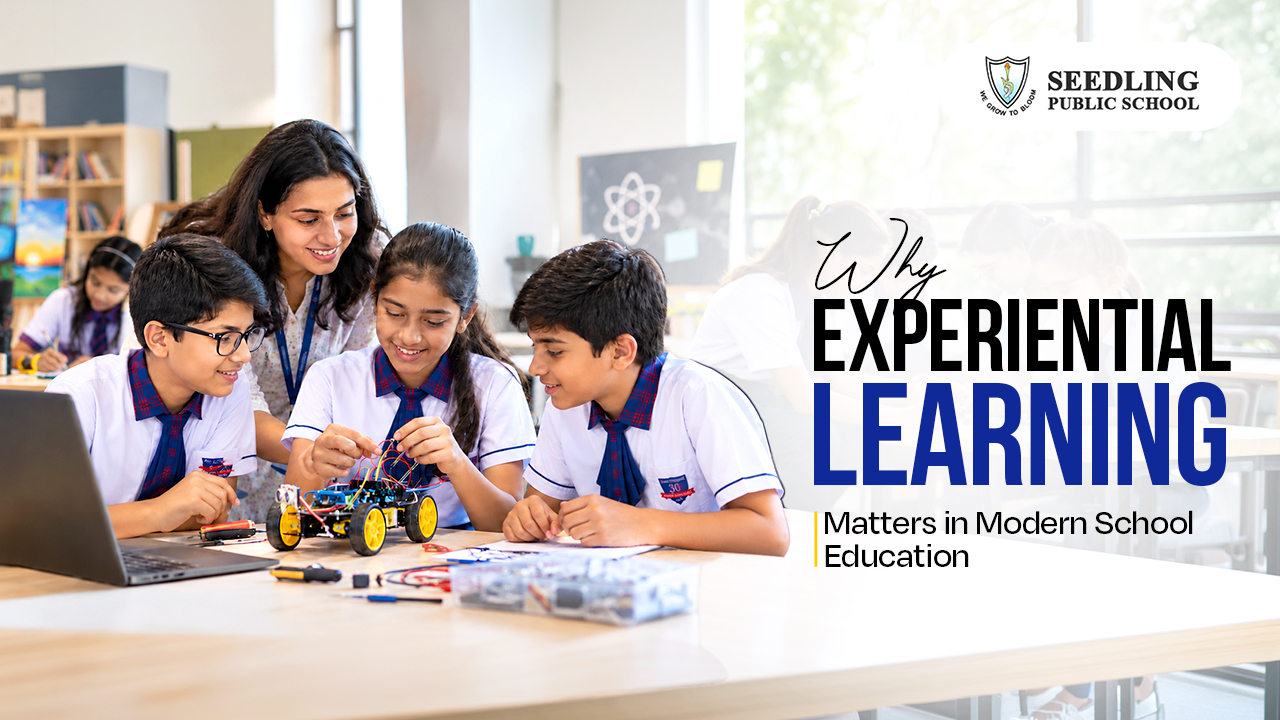
Experiential learning helps bridge this gap by giving students opportunities to investigate questions, conduct experiments, work on projects, and solve practical problems. These experiences help them connect classroom concepts with real-life situations, reflect on what they discover, and develop skills such as critical thinking, collaboration, and independent decision-making.
Rather than replacing textbook learning, experiential learning complements it by helping students understand concepts more deeply and prepare to use their knowledge beyond examinations.
In This Article
What Is Experiential Learning?
Experiential learning is an approach in which students develop knowledge and skills through direct experiences, followed by reflection on what they have learned. Rather than relying only on textbooks and explanations, students engage in activities that help them explore concepts, solve problems and connect classroom learning with real-life situations.
Admissions Open
Give Your Child the Best Start
Join Seedling Modern High School and unlock a world-class learning environment built for tomorrow's leaders.
Apply for Admission →The Association for Experiential Education (AEE) highlights the importance of direct experience and focused reflection in the learning process. In a school setting, this approach can include science experiments, research projects, group discussions, fieldwork and practical problem-solving activities.
For example, instead of only reading about water conservation, students could investigate water usage, analyse their observations and suggest ways to reduce wastage. The activity becomes more meaningful when students reflect on their findings and connect them with what they have learned in class.
Experiential learning does not replace classroom teaching. It complements it by giving students opportunities to apply, question and deepen their understanding of academic concepts.
At Seedling Modern High School, experiential learning can be explored through the school’s stated emphasis on practical learning, critical thinking and real-world application.
Why Does Experiential Learning Matter?
1. It Connects Classroom Learning With Real Life
Experiential learning helps students understand how academic concepts apply to situations beyond the classroom. Instead of only reading about water conservation, for example, students could investigate water usage, analyse their observations, and suggest ways to reduce wastage. Similarly, business concepts can be explored through case studies, budgeting exercises, or practical problem-solving activities.
However, the activity itself is only one part of the learning process. Reflection helps students make sense of their experience. By discussing what they observed, explaining why a solution worked, or considering what they would do differently, students can connect practical experiences with classroom concepts and apply their understanding to new situations.
This approach encourages students to move beyond memorising information and develop a clearer understanding of how and why it works in real life.
2. It Encourages Critical Thinking
Modern education needs to prepare students to think independently. Experiential activities often do not have a single obvious answer. Students may need to analyse information, compare possibilities, identify problems, and decide which solution makes the most sense.
These experiences can strengthen skills such as:
- Logical reasoning
- Analysis
- Decision-making
- Problem-solving
- Independent thinking
These abilities can be valuable not only in examinations but also in higher education and everyday life.
3. It Builds Confidence
A student who regularly gets opportunities to participate, experiment, and present ideas can gradually become more comfortable expressing their thoughts.
Group projects, presentations, classroom discussions, exhibitions, and practical activities can encourage students to take initiative.
The Seedling approach also places emphasis on developing communication, leadership, creativity, and problem-solving alongside academic learning.
For senior secondary students, this confidence can become especially important as they begin making decisions about subjects, higher education, and future career paths.
4. It Develops Collaboration Skills
Learning does not always happen individually. Many experiential activities involve students working in teams. They may have to divide responsibilities, listen to different opinions, complete a shared project, and present the final outcome.
This teaches students that successful collaboration requires communication, accountability, and respect for other perspectives.
Such skills are increasingly relevant in college and professional environments, where working effectively with others is an important part of most academic and career settings.
6. It Encourages Creativity and Innovation
Experiential learning gives students opportunities to explore different approaches, test ideas, and develop their own solutions. Instead of always working towards a predetermined answer, students can learn to consider alternatives, experiment with possibilities, and improve their ideas based on what they discover.
This process encourages curiosity, flexible thinking, and a willingness to learn from mistakes. Students also begin to understand that solving a problem may require several attempts rather than one immediate answer.
These experiences can help students become more resourceful and adaptable, qualities that are valuable in higher education and in situations where they need to approach unfamiliar challenges.
Experiential Learning in Senior Secondary Education
In senior secondary classes, experiential learning helps students connect academic concepts with practical situations while developing greater independence in their learning. The activities should complement the curriculum and give students opportunities to investigate questions, analyse information, and apply their understanding.
Science
Laboratory experiments and investigations allow students to test concepts, record observations, interpret results, and draw conclusions based on evidence.
Commerce
Business case studies, budgeting exercises, and financial analysis activities help students apply concepts from accounting, economics, and business studies to practical situations.
Humanities
Research assignments, debates, and field studies encourage students to examine evidence, compare perspectives, and develop reasoned arguments about social and historical issues.
Across these subjects, the emphasis is not simply on completing an activity. It is on helping students reflect on their experience, understand the concepts involved, and apply their learning to new situations.
What Should Parents Look for in a School?
Parents comparing schools should look beyond facilities and academic results alone. They can also ask how students actually learn during a normal school week.
Some useful questions include:
- Are students given opportunities for hands-on learning?
- Does the school encourage questions and discussion?
- Are practical activities connected to classroom concepts?
- Do students participate in projects and presentations?
- Are laboratories and technology used meaningfully?
- Does the school encourage collaboration and creativity?
- Are students given opportunities to solve real-world problems?
These questions can help parents understand whether experiential learning is genuinely part of the school’s educational approach or simply mentioned as a feature.
Seedling’s Approach to Experiential Learning
The Seedling Group of Schools presents education as a journey that combines academic learning with curiosity, reasoning, creativity, and real-world application.
Seedling Modern High School specifically highlights experiential learning, critical thinking, and personalised attention as part of its academic approach. Its current school information also describes STEM laboratories, computing facilities, collaborative spaces, and opportunities for learning beyond the classroom.
This type of environment can help students understand that education is not simply about completing a syllabus. It is also about developing the ability to question, explore, communicate, and apply knowledge.
The Role of Teachers in Experiential Learning
Teachers remain central to experiential education. An activity by itself does not automatically create meaningful learning. Teachers need to guide students, ask questions, encourage reflection, and help them connect their experiences with academic concepts. Instead of giving students every answer immediately, teachers can encourage them to investigate a problem and arrive at their own conclusions.
This changes the classroom dynamic. The teacher becomes not only a source of information but also a mentor who helps students learn through exploration.
Conclusion
Experiential learning matters because it helps bridge the gap between what students learn and how they use that knowledge. Through projects, experiments, discussions, practical activities, and real-world problem-solving, students can develop deeper understanding along with critical thinking, creativity, collaboration, and confidence.
For parents choosing a senior secondary school in Jaipur, looking at how a school puts learning into practice can be just as important as looking at its academic curriculum. A modern school should prepare students not only to perform well in examinations but also to think independently and approach the world with curiosity and confidence.
Frequently Asked Questions
1. How does experiential learning differ from traditional classroom learning?
Traditional learning often focuses on explaining concepts, while experiential learning helps students understand them through activities, experiments, projects, and real-world applications.
2. How is experiential learning integrated into the school curriculum?
Teachers integrate experiential learning through subject-based projects, laboratory experiments, group activities, field visits, and practical tasks linked to syllabus concepts.
3. What are some examples of experiential learning in everyday life?
Students apply experiential learning by preparing budgets, measuring ingredients, comparing reliable information sources, conducting simple experiments, and solving everyday problems.
4. What skills can students develop through experiential learning?
Experiential learning can develop critical thinking, communication, collaboration, creativity, decision-making, and problem-solving through practical tasks and reflective activities.
5. How do teachers evaluate students during experiential learning activities?
Teachers may assess students’ reasoning, participation, research, evidence, practical execution, final outcomes, and reflections, depending on the activity’s learning objectives.
Ready to Enrol?
Begin Your Admission Journey
Seats are limited. Secure your child's place at Seedling Modern High School today.
Enquire Now →Written by
SPS Editorial Team
SPS Editorial Team creates trusted educational content for Seedling Public School (SPS). Our articles are developed with insights from experienced educators and academic professionals, ensuring every piece is accurate, practical, and relevant. We are committed to providing reliable resources that support students, parents, and lifelong learning.